
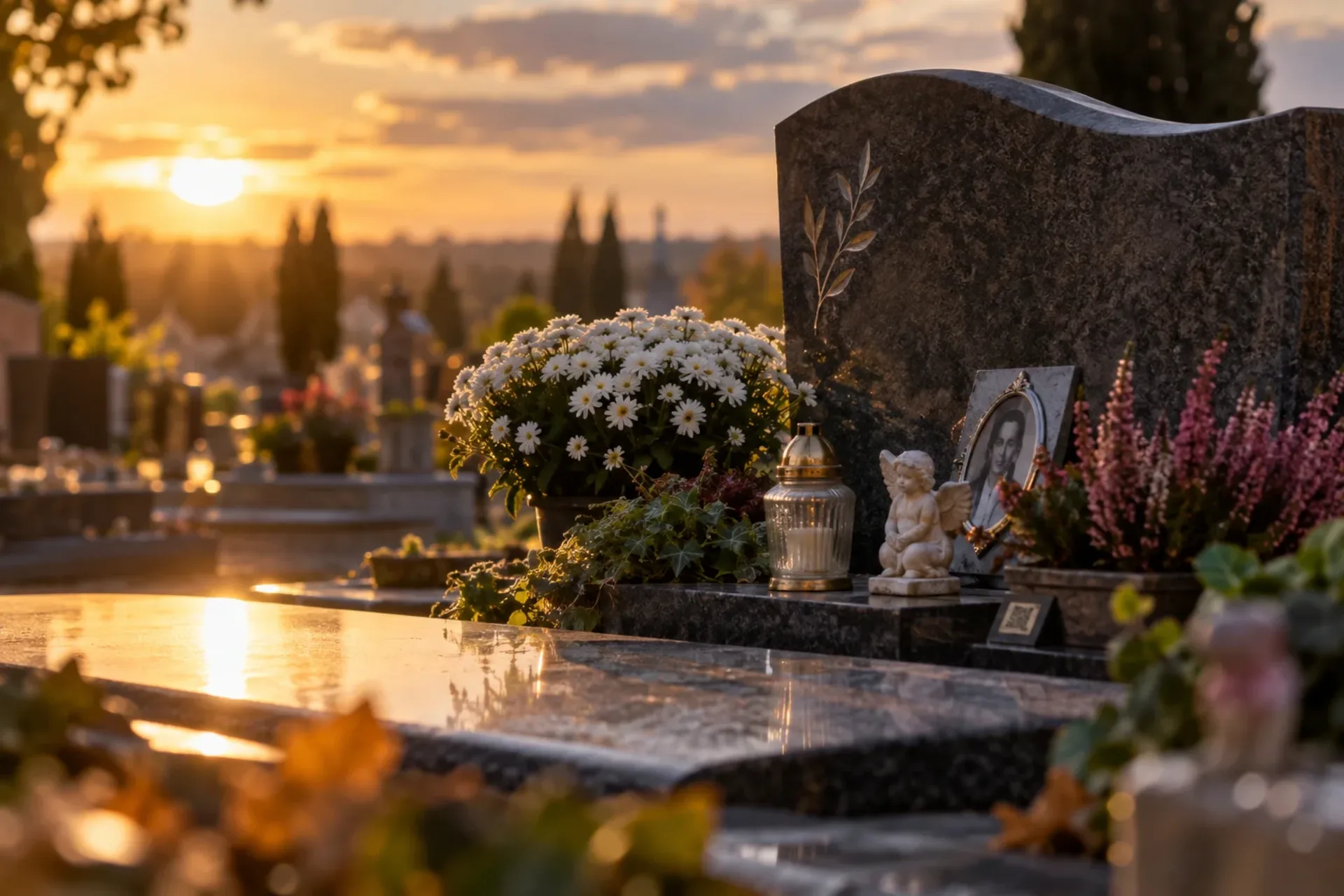
Personalizing a grave allows you to create a place of remembrance that truly evokes the person who has passed. Flowers, memorial plaques, photographs, engravings, symbolic objects or even a QR code providing access to an online memorial: there are many ways to make a burial site more personal.
The choice depends above all on the personality of the deceased, the memories you wish to preserve, the possible maintenance and the rules applicable in the cemetery.
Here are 12 ideas for personalizing a grave, from the most traditional to the most contemporary.
1. Choose flowers that recall the person who has passed
Flowers are probably the most familiar way to adorn a burial site. But rather than choosing only according to the season, you can draw inspiration from your loved one’s tastes.
Did they particularly like roses? Did she grow lavender in her garden? Did a certain color often appear in their bouquets?
This detail is enough to transform a floral decoration into a personal tribute.
For a grave visited infrequently, prefer plants suited to the exposure and local climate, requiring little maintenance. Also consider choosing pots stable enough to withstand wind and bad weather.
2. Have a personalized memorial plaque made
A memorial plaque allows you to go beyond the information engraved on the monument alone.
It can include a few words, a quote, a motif or an illustration evoking the personality of the deceased.
A very simple message can sometimes be more personal than a long formula:
- “Your laughter still accompanies our memories.”
- “To our dad, for everything you passed on to us.”
- “Always with us.”
Personalization can also come through the shape, material or design of the plaque: landscape, tree, mountain, sea, music or any other symbol with particular meaning.
3. Add a medallion with their photograph
A photograph brings an immediately personal dimension to a burial site: it allows you to find a face behind a name and dates.
The funeral medallion is specifically designed for this use.
Preferably choose a clear portrait on which the person is easily recognizable. It does not have to be an official photograph: a familiar image, more in line with how loved ones remember them, can be very meaningful.
Simply make sure to use a support designed to last outdoors.
4. Engrave a phrase that suited them
An epitaph does not have to be a solemn formula.
It can repeat a few words that tell the person’s story: a value they embodied, an expression they often used or a phrase that evokes their journey.
Since space is limited, prefer a short phrase that remains understandable even by someone who did not know the deceased directly.
A few well-chosen words can span generations.
5. Use a symbol linked to a passion
Personalizing a grave can also evoke what the person loved to do.
Music, gardening, travel, reading, mountains, sea, sports, animals, crafts…
An engraved motif or a small decorative element can discreetly recall this passion.
The goal is not to accumulate objects, but to choose a symbol capable of immediately evoking a memory.
A small sailboat can recall years spent at sea. A musical note can evoke an instrument played all one’s life. A tree can represent attachment to nature or to family.
6. Create a lasting plant composition
A grave can also be personalized with plants chosen to last longer than a bouquet of cut flowers.
Depending on the space available and the conditions of the site, potted plants or small plant compositions can accompany the burial site through the seasons.
Before choosing a plant, consider its sun exposure, water needs, cold resistance and how often someone will be able to maintain it.
A simple composition adapted to the site will generally be preferable to a decoration requiring care that cannot be provided regularly.
7. Place an object charged with a story
Some objects take on particular value because they are associated with a family memory.
It may be a decorative element evoking a passion, a small pebble brought back from a beloved place or a symbolic object chosen by children or grandchildren.
However, it is preferable not to place on the grave an original object to which the family is very attached. Exposure to the elements, damage or disappearance of the object remain possible.
A reproduction or a symbol designed for outdoor use makes it possible to preserve the intention without risking the loss of an irreplaceable memory.
8. Personalize the grave according to the seasons
A burial site does not necessarily need to keep exactly the same appearance all year round.
Some families adapt the flowers or a few decorative elements to the seasons and important moments: birthdays, date of death, family holidays or All Saints’ Day.
This allows the place of memory to evolve with the rhythm of visits.
Personalization can remain very simple: a particular flower on an important date is sometimes enough to give meaning to a visit.
9. Involve children and grandchildren
Personalizing a grave can also become a way to pass on family memories.
A child can choose a flower, draw something that will be kept by the family, select a photograph or simply listen to an anecdote told in front of the burial site.
For generations that have little or not known the person who passed, these moments allow them to gradually understand who they were.
The grave then no longer represents only a name and two dates: it also becomes the starting point of a family story.
10. Favor sober decoration around a strong memory
Personalizing does not necessarily mean adding many elements.
A single photograph, a plaque accompanied by a few words or a carefully chosen plant may be enough.
Before adding a new element, ask yourself a simple question:
What does this say about this person?
This approach makes it possible to create a coherent whole and avoid the accumulation of decorations overshadowing what really matters: the memory to which they refer.
11. Add a QR code to tell their story beyond the stone
A headstone allows a name, dates and a few words to be inscribed. But an entire life does not fit in an inscription.
A memorial plaque with QR code allows the tribute to continue by linking the burial site to an online memorial.
The principle is simple: the visitor scans the QR code with the camera of their smartphone. A page dedicated to the person who passed then opens in their browser.
This page can bring together their story, photographs, videos and memories shared by loved ones.
The grave thus retains its sobriety, while those who wish to discover more can access a much richer memory.
With Memoraluna, the content of the memorial can continue to evolve after the plaque is installed: new photographs or new memories can be added without replacing the QR code.
This is notably a way to pass on a person’s story to children and grandchildren who did not know them, or who were too young to retain many memories of them.
12. Create a family memorial that loved ones can enrich
Personalization can finally go beyond the physical place.
Memories of a person are rarely held by only one person: one holds the childhood photographs, another remembers an anecdote, while a grandchild keeps a video or a story told during a meal.
Creating an online memorial makes it possible to gradually bring together these fragments of a life in a single space.
With a Memoraluna memorial, several loved ones can participate in this transmission, while the family retains control over the published content and the privacy level of the memorial.
Combined with a QR code plaque placed on the burial site, this space creates a link between the place where one comes to pay respects and the story of the person one wishes to transmit.
How to choose the right way to personalize a grave?
There is not only one right way to personalize a burial site.
To make your choice, you can start from four questions:
- What really represented this person?
- What memory would we like to pass on to future generations?
- What maintenance can we ensure over time?
- Is the envisaged decoration suited to the monument and the rules of the place?
It is also useful to discuss it with other loved ones when several family members pay their respects at the same burial site.
The goal is not to completely transform the monument, but to create a place in which the family recognizes something of the person who has passed.
Can you put whatever you want on a grave?
In France, article L2223-12 of the General Code of Local Authorities provides that an individual may place on the grave of a relative or friend a sepulchral stone or another indicative sign of burial.
This does not mean, however, that all installations can be carried out without precaution.
The cemetery regulations, the nature of the monument, fixing methods and certain interventions may impose constraints. Before permanently fixing a plaque, modifying the monument or installing an unusual element, it is therefore prudent to consult the cemetery regulations and, in case of doubt, to inquire with the town hall or the relevant manager.
For a QR code plaque, it is also necessary to check the applicable rules at the site before installation.
Frequently asked questions about personalizing a grave
How to personalize a grave simply?
A few elements are enough: flowers appreciated by the deceased, a plaque with a personal message, a photo medallion or a symbol recalling a passion. The essential thing is to choose something that truly evokes the person rather than multiplying decorations.
What can be placed on a grave instead of flowers?
A memorial plaque, a photo medallion, an outdoor decoration, a symbolic object or a plaque with a QR code can complement or replace flowers. Remember to check the cemetery rules before any permanent fixing.
How to embellish a grave without much maintenance?
Favor sober and resistant decoration: memorial plaque, medallion suited for outdoor use, stone or metal elements and, if you wish for plants, plants suited to the climate and the frequency of your visits.
Can you put a photo on a grave?
Yes, notably using a funeral medallion designed to withstand the outdoors. It is preferable to use a suitable support rather than a photograph or frame intended for indoors.
Can you put a QR code on a grave?
A QR code can be integrated into a small plaque fixed on a suitable surface of the monument. It allows a smartphone to open a page dedicated to the deceased. Before installation, check the regulations and any instructions from the cemetery or the monument manager.
What is the purpose of a QR code on a grave?
The QR code creates a link between the burial site and a digital memorial. Once scanned, it can allow access to the person’s biography, photographs, videos and memories shared by loved ones.
Do you need an application to scan a Memoraluna QR plaque?
No. On compatible smartphones, simply use the camera to scan the QR code. The memorial then opens directly in the browser, without installing a Memoraluna application.
Making the burial site a point of transmission
Personalizing a grave is above all choosing what one wishes to continue telling about the person who has passed.
A flower can recall their garden. A photograph, their face. A few words, their way of being. An object, a passion.
And when the stone is no longer enough to tell an entire story, the digital can extend it without taking the place of the place of remembrance.
Memoraluna combines a discreet QR code plaque with a family online memorial, where the story, photographs, videos and memories of a loved one can be gathered.
The plaque then becomes a gateway to what could not be engraved on the stone: the story of a life.